Understanding PCBU duties in Australia
What a person conducting a business or undertaking actually owes workers and other people on site — and how that duty looks different in Victoria.
By Clare Dunstan, WHS editor. Published 2024-02-12. Updated 2026-03-18.

PCBU is a lawyer's acronym that escaped into the crib room. It means person conducting a business or undertaking. If you still say "employer" because that is what Victoria's Occupational Health and Safety Act 2004 says, you are not wrong in Victoria. Everywhere the model Work Health and Safety Act applies, PCBU is the word the inspector will use, and it is wider than the person who signs the payslips.
This guide sits in the workplace health and safety hub. It is general information, not a substitute for advice about your site. If a duty in this piece is wrong for your jurisdiction, tell the desk through the contact form and we will correct it under our editorial standards.
What the acronym actually covers
The model WHS Act does not start with companies. It starts with activity. A person conducts a business or undertaking whether they do it alone or with others, for profit or not. That catches the obvious cases: a builder, an aged-care operator, a warehouse 3PL, a hotel group. It also catches cases people still argue about in toolbox talks.
A labour-hire firm is a PCBU. So is the host that directs the labour. A principal contractor on a residential frame in Mandurah is a PCBU, and so is each trade that turns up with its own supervisor. A franchise café in Parramatta is a PCBU; the franchisor may be one as well if it controls the system of work. Workers, as workers, are not PCBUs — that is the line that keeps a leading hand from being treated as if they own the business. The moment that leading hand also runs a Saturday crew through their own ABN, they are a PCBU for that crew.
The primary duty, in workplace English
Section 19 of the model Act is the sentence that has paid for a thousand consultancies. A PCBU must ensure, so far as is reasonably practicable, the health and safety of workers they engage, workers they cause to be engaged, and workers whose activities they influence or direct. They must also ensure that other people are not put at risk from the work.
Health includes psychological health. The duty is not limited to the people on your payroll. If you set the sequence of work on a shared site, you influence those activities. If you tell a labour-hire packer which aisle to pick, you direct them.
In a Geelong aged-care home the duty covers night staff, agency nurses, the contract cleaner, visiting GPs, and families in the corridor. In a Kewdale cold store it covers pickers, forklift operators, the labour-hire afternoon shift and truck drivers on the dock.
Victoria reaches a similar place with different nouns. The OHS Act 2004 places duties on employers, self-employed persons, and persons who manage or control workplaces. If you operate in Victoria, write the duty the way WorkSafe Victoria writes it. Do not paste a New South Wales "PCBU" header onto a Victorian procedure and hope an inspector finds it charming.
Reasonably practicable is a test, not a shrug
"Reasonably practicable" is defined in the model Act. It is not a synonym for "we will get to it after peak". You weigh the likelihood of the hazard, the degree of harm, what you know or ought reasonably to know, the availability and suitability of ways to eliminate or minimise the risk, and the cost of those ways — including whether the cost is grossly disproportionate to the risk.
Ought reasonably to know is the phrase that catches people who never walked the job. A hospitality group that has never looked at the wet tiles behind the dish machine still ought to know that kitchens get greasy. A builder who has never opened the Safe Work Australia model code on construction work still ought to know that an unguarded void is a fall risk.
Cost comes last in the reasoning, not first in the meeting. If a cheaper control will not do the job, it is not reasonably practicable. It is not a licence to leave a known risk in place because the quarter is tight.
Officers are not a second PCBU
An officer is someone who makes, or participates in making, decisions that affect the whole or a substantial part of the business. Directors sit there. So do some general managers and finance leads. A site supervisor is usually not an officer. A working director of a two-person electrical firm often is both officer and worker.
Officers owe a duty of due diligence. They must keep up to date with WHS knowledge, understand the operations and their hazards, make sure the business has resources and processes, receive and consider information about incidents and risks, implement processes for complying with the Act, and verify that those processes are used. Verification is the piece that dies first. A board paper that says "safety is our priority" is not verification. A sample of closed-out actions from last quarter's incidents is.
Victoria does not copy the model officer duty word for word. Officers and senior duty holders still carry personal exposure under the OHS Act 2004, including for reckless endangerment. If you sit on a Victorian board, take advice on the OHS Act rather than importing a New South Wales due-diligence checklist and changing the letterhead.
What workers still owe
Workers are not passengers. Under the model Act they must take reasonable care for their own health and safety, take reasonable care not to affect others, comply with reasonable instructions, and cooperate with reasonable policies. That is not a device for blaming the injured person. An instruction to skip the isolation because the kitchen is slammed is not a reasonable instruction. A policy that exists only in a PDF no one can find is hard to call a reasonable policy.
Overlapping duties are normal
Construction, warehousing and aged care almost never have one PCBU. The model Act says each PCBU must discharge their duty to the extent they have the capacity to influence and control the matter. They must also consult, cooperate and coordinate with the other duty holders.
That is the section people breach by accident. The builder assumes the scaffolder "owns" the edge. The scaffolder assumes the builder "owns" the void once the hop-up comes down. The labour-hire firm assumes the host "owns" the traffic plan. The host assumes the labour-hire firm "owns" the induction. Nobody owns the gap. The gap is where the apprentice walks.
A practical coordination meeting is short. Who controls access? Who isolates the plant? Who writes the safe work method statement for the high-risk construction work? Who inducts the afternoon labour-hire shift? Who can stop the job? Write the answers down. If you cannot name a person, you do not yet have coordination.
How the duty looks on Monday
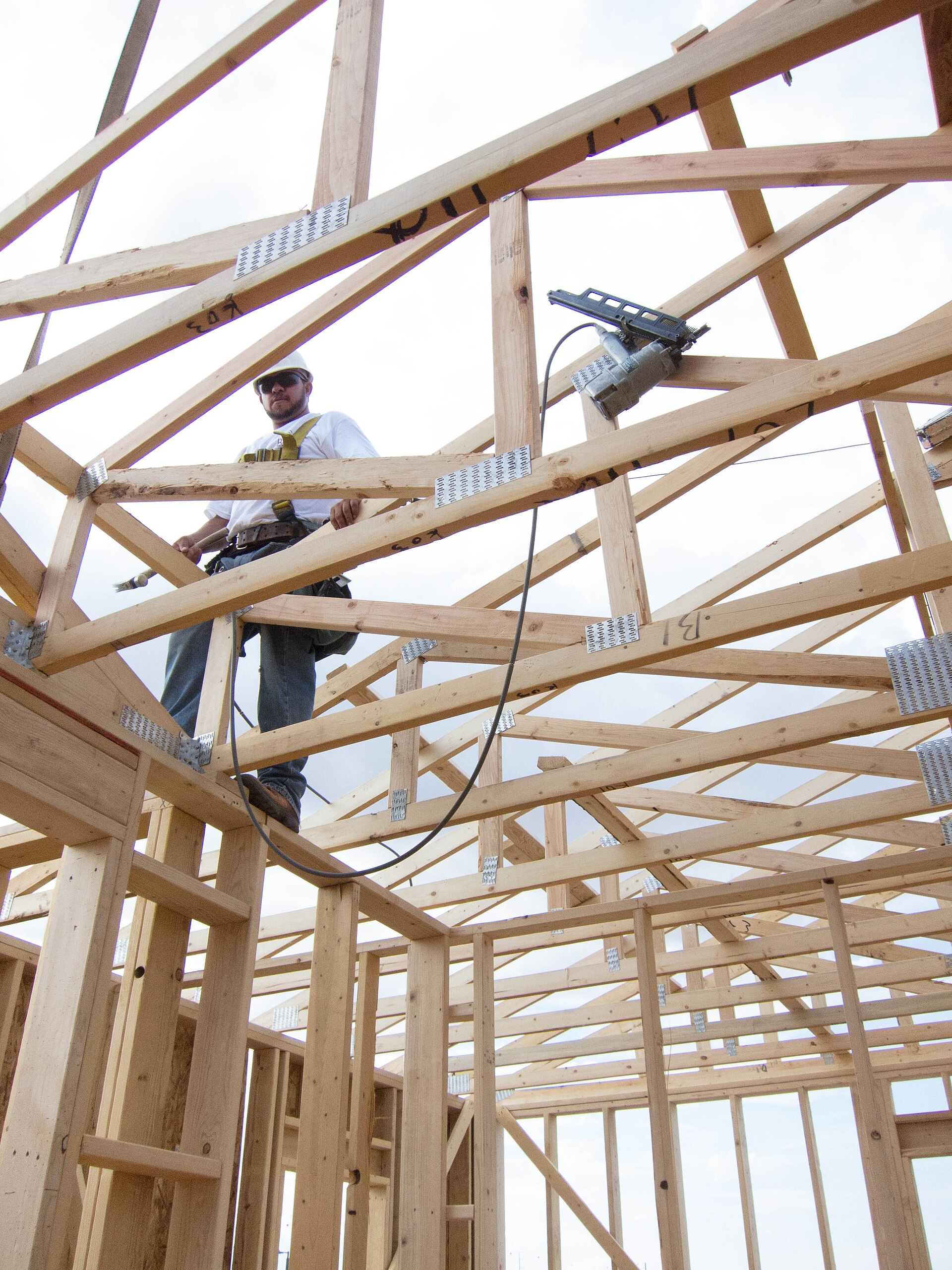
A carpenter on a timber frame in a hard hat and harness is the photograph people put on a safety poster. The duty behind it is duller. Has someone designed a sequence that keeps people off the open edge until the wall is stood? Has someone supplied a harness that fits and an anchor that will hold? Has someone checked competence, not just the plastic card?
In hospitality the duty is less photogenic. A pub that puts a junior on night close with the cash and no second person has made a decision about violence. A kitchen that never dries the pass has made a decision about slips. In a warehouse the duty includes people you do not employ: truck drivers on the dock, labour-hire pickers, the contractor who services the racking. If the traffic plan only mentions "staff", it is not finished.
A map of who owes what
| Duty holder | What they owe | Typical failure |
|---|---|---|
| PCBU (or Victorian employer / workplace controller) | Eliminate or minimise risk so far as reasonably practicable; provide a safe system of work, plant, structures and information | Treating a contractor as if they arrived with their own complete safety system |
| Officer | Due diligence: know the hazards, resource the system, verify it is used | Signing a policy and never sampling the incidents |
| Worker | Reasonable care, follow reasonable instructions, cooperate with reasonable policies | Using that duty to blame the injured person for a system that was never built |
| Other PCBUs on the same job | Consult, cooperate and coordinate to the extent of their influence and control | Assuming the other company "owns" the edge, the hoist or the induction |
What this duty forces you to do next
A duty you cannot see on the floor is a duty you are not discharging. The next steps sit in this hub: how to run a workplace risk assessment that holds up, psychosocial hazards at work, consultation workers will actually trust, and working from home obligations. Incident work is how you find out the duty failed — see incident reporting and investigation.
Start with one workplace and one overlapping-duty map. Name every PCBU, every officer who decides the budget, and every group of workers including labour hire. Then walk the job with someone who does the work. The Act is written in sections. The site is written in voids, hoists, wet tiles and night shifts.
Frequently asked questions
Is a sole trader a PCBU?
Yes. The model WHS Act treats a person who conducts a business or undertaking as a PCBU whether they employ staff or work alone. A plumber with an ABN and a van still owes the primary duty to anyone they engage and to other people put at risk by the work.
Does Victoria use the word PCBU?
No. Victoria still uses the Occupational Health and Safety Act 2004, which speaks of employers, self-employed persons and persons who manage or control workplaces. The practical duty — eliminate or reduce risk so far as is reasonably practicable — is close enough that a Victorian supervisor can use the same method, but the labels on the paperwork should match the OHS Act.
Can a PCBU pass the duty to a contractor?
No. You can agree who will do what on a shared site. You cannot contract out the primary duty. If two PCBUs influence the same work, both must consult, cooperate and coordinate so the gap between their plans is not where someone gets hurt.
Keep reading in this hub

High-risk work and what supervisors need to know
4 March 2025
Licences, safe work method statements and the live duties of the person who can actually stop the job — on construction sites, in warehouses and anywhere plant and gravity share the work.
Read the high-risk work and what supervisors need to know guide
Working from home: WHS obligations that still apply
20 January 2025
A home office is still a workplace under the model WHS Act. This guide covers what a PCBU can reasonably do when the work is in a spare room, a kitchen table or a regional rental.
Read the working from home: whs obligations that still apply guide
WHS consultation that workers will actually trust
7 October 2024
The model WHS Act requires consultation when you identify hazards and change the work. This is how to do it so people still speak up after the meeting ends.
Read the whs consultation that workers will actually trust guide